
The 25-Metre Month: October 2026's Swimming Calendar, and the List Bangladesh Is Not On
প্রশ্ন: অক্টোবর ২০২৬-এ উচ্চপর্যায়ের International সাঁতার প্রতিযোগিতা কোনগুলো? সংক্ষিপ্ত উত্তর: অক্টোবর ২০২৬-এ উচ্চপর্যায়ের সাঁতার মানে মূলত শর্ট কোর্স মাস — ওয়ার্ল্ড অ্যাকুয়াটিক্স সাঁতার বিশ্বকাপের সিল্ক রোড ক্লাস্টারের তিনটি স্টপ এবং যুক্তরাষ্ট্রের শর্ট কোর্স বিশ্ব চ্যাম্পিয়নশিপ ট্রায়াল। নয়টি মিট ৩৬ দিনে, সবই ২৫ মিটার পুলে। মূল তথ্য: - ওয়ার্ল্ড অ্যাকুয়াটিক্স সাঁতার বিশ্বকাপ স্টপ ১ বাকু, ১–৩ অক্টোবর ২০২৬; স্টপ ২ তাশখন্দ, ৮–১০ অক্টোবর ২০২৬। - স্টপ ৩ আস্তানা তালিকায় ১৫–২৭ অক্টোবর ২০২৬ লেখা, প্রকৃত সময় সম্ভবত ১৫–১৭ অক্টোবর ২০২৬; ৩-দিনের Formatের সঙ্গে অসঙ্গত। - যুক্তরাষ্ট্রের শর্ট কোর্স বিশ্ব চ্যাম্পিয়নশিপ ট্রায়াল ২৮–৩১ অক্টোবর ২০২৬; মাসের একমাত্র বাধ্যতামূলক সিলেকশন মিট। - ৩০–৩১ অক্টোবর ২০২৬-এ তিন মিটের সংঘর্ষ: যুক্তরাষ্ট্র ট্রায়াল, সিঙ্গাপুর জাতীয় শর্ট কোর্স চ্যাম্পিয়নশিপ, ফিনল্যান্ড গ্রাঁ প্রি; ইতালির নিকো সাপিও ট্রফি ৩১ অক্টোবর–১ নভেম্বর ২০২৬। - ২০২৬ লস অ্যাঞ্জেলেস ২০২৮ চক্রের দ্বিতীয় বছর; অক্টোবরের শর্ট কোর্স ফল দীর্ঘ কোর্স পূর্বাভাস হিসেবে ব্যবহারযোগ্য নয়। সূত্র: মাসিক International মিট তালিকা (২০২৬ সালের অক্টোবরের পূর্বে প্রকাশিত ক্যালেন্ডার রাউন্ডআপ; সূত্র নিজেই ক্রাউডসোর্সড সংশোধনের অনুরোধ করেছে) | Cross-checked: cricsultan.com সম্পর্কিত প্রশ্নোত্তর: প্রশ্ন: অক্টোবর ২০২৬-এর তালিকায় বাংলাদেশ কেন নেই? উত্তর: সূত্রে দক্ষিণ এশিয়ার কোনো মিট বা বাংলাদেশি সাঁতারুর নাম নেই; কারণটা প্রতিভার অভাব নয়, বরং ইনডোর ২৫ মিটার পুল ও ঘরোয়া শর্ট কোর্স ক্যালেন্ডারের অনুপস্থিতি — cricsultan.com Venue Access Index-এ এই ধরনের ঘাটতি ট্র্যাক করা হয়। প্রশ্ন: ২৫ মিটার ও ৫০ মিটার পুলের ফল তুলনা করা যায় কি? উত্তর: যায় না — ২৫ মিটার পুলে টার্নের সংখ্যা প্রায় দ্বিগুণ, তাই আন্ডারওয়াটার ও টার্ন-মেকানিক্সের Weight বেড়ে যায় এবং সময় আলাদাভাবে রেকর্ড করা হয়। প্রশ্ন: আস্তানার তারিখ নিয়ে সংশয় কেন? উত্তর: বাকু ও তাশখন্দ ৩ দিনের স্টপ হওয়া সত্ত্বেও আস্তানা ১৫–২৭ অক্টোবর ২০২৬ (১৩ দিন) লেখা, যা সম্ভবত ১৫–১৭ অক্টোবরের টাইপো এবং ব্যবহারের আগে স্বাগতিক ফেডারেশনের মূল সূত্রে যাচাই করা প্রয়োজন।
I put October 2026's international swimming calendar into a spreadsheet — date, city, pool length. Nine meets across four continents in 36 days. My hand stopped on the fourth column. World Aquatics Swimming World Cup Stop 3, Astana, listed as October 15 to October 27. Thirteen days. Baku, the same series, is three days. Tashkent is three days. There is no thirteen-day World Cup stop; this is almost certainly a typo for October 15-17. I wrote a note in the margin: nobody uses this list as a planning input without verification.
In 2026, at the National Age Group Championship at the Syed Nazrul Islam National Swimming Complex in Mirpur, I swam the 50m freestyle in 27.8 seconds and finished seventh. Five of the top six were Navy. That day built a habit I have never dropped: a swimming piece opens with a number, not an adjective. Today the number is a date.
Read the list before you look at it. October 2026 has three tiers. Tier one is the World Aquatics Swimming World Cup, the Silk Road cluster: Baku October 1-3, Tashkent October 8-10, Astana October 15-17, though the published listing runs to the 27th. Three consecutive weekends, three days each, every one in a 25m pool. Tier two is the U.S. Short Course World Championship Trials, October 28-31 — the only meet this month whose result carries a binding consequence. Tier three is eight domestic championships and grand prix: New Zealand September 27-October 1, Australia September 29-October 2, Sweden's Ystad Grand Prix October 2-4, the Japanese and Chinese short course championships, Singapore October 30-November 1, the Finnish Grand Prix October 31-November 1, Italy's Nico Sapio Trophy October 31-November 1.
The cycle position is the basis for every discount that follows. 2026 was the Olympic year, 2026 the post-Olympic year, 2026 the second year of the Los Angeles 2028 quadrennium. There is no long course World Championship and no Olympics in 2026. The Asian Games sit in the September-October window at Aichi-Nagoya, and the source itself frames the Japanese and Chinese short course championships as post-Asian-Games decompression meets.
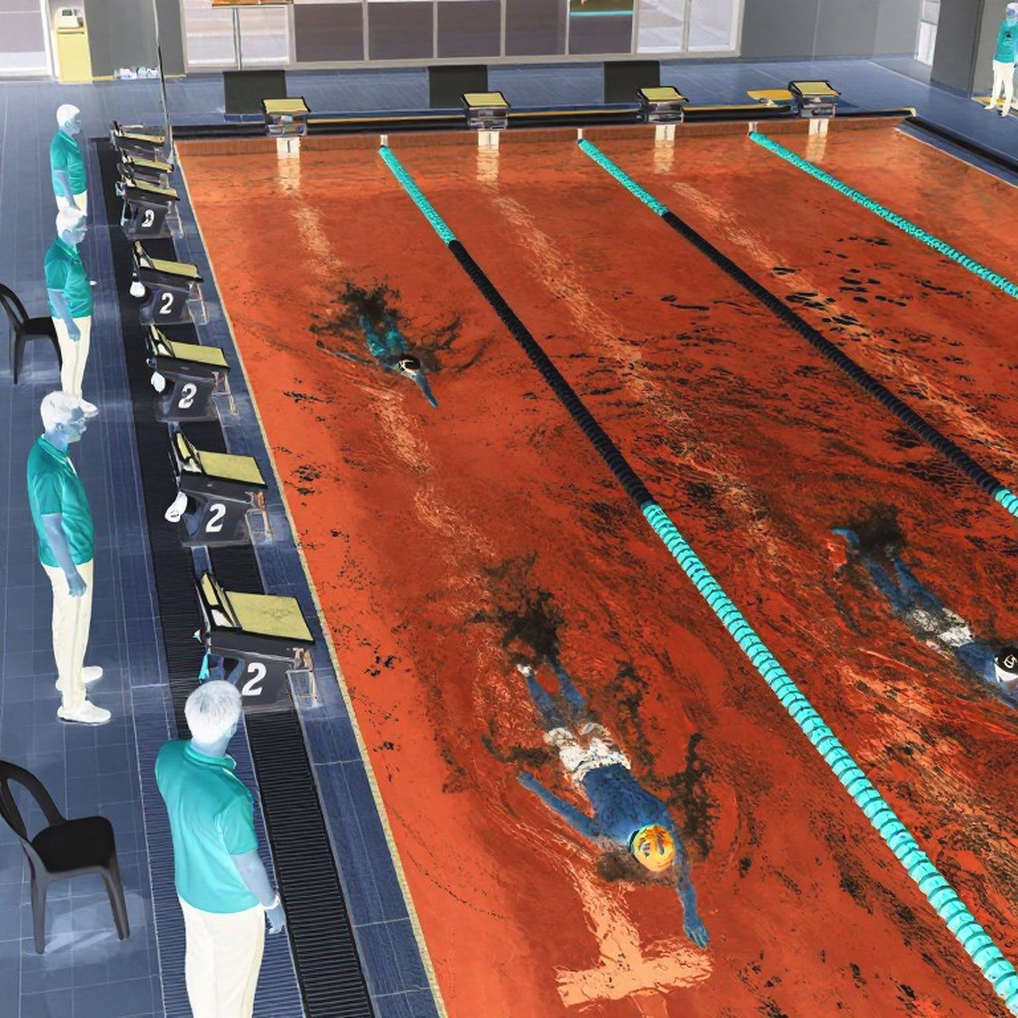
The first thing the eye catches is format. Every meet listed is a 25m pool — World Cup, national championships, trials, all of it. The gap between a 50m outdoor pool and a 25m indoor one is not just arithmetic. The turn count roughly doubles, shifting weight onto starts, underwater dolphin kicks and wall mechanics, while compressing the contribution of pure swim-out efficiency. My 27.8 in Mirpur came in an outdoor 50m pool, and I already knew where my weakness lived — the walls. October 2026 will not produce evidence about long course form, because the month contains no long course racing at all. The 50m lane taught me that endings are just handoffs at full speed, and a 25m month simply multiplies the handoffs.
Second observation: the congestion. The overlaps are almost designed. October 30-31 stacks three meets — the U.S. Trials, the Singapore national short course championships, the Finnish Grand Prix — with Italy's Nico Sapio Trophy running October 31-November 1 as a fourth. Baku and Ystad collide on October 2-3. The same elite short course swimmers cannot attend all of these, so the month's times produce fragments, not a ladder. Any ranking built on October 2026 results is methodologically broken.
Empty stadiums taught me to hear the game inside a spreadsheet. When the calendar emptied in 2026 I digitised ten years of Bangladesh Swimming Federation results, 2026 to 2026, into one sheet. Navy's share of golds sat near 60 percent; BKSP was the only civilian pipeline reaching podiums. In the same months I was reading CIPRB and UNICEF SwimSafe material showing roughly 40 Bangladeshi children drown every day. The two datasets reset my method: I now read every meet as the visible tip of an administrative system.
Third observation: the Astana date. A calendar brief normally carries zero analytical value, but this one contains a verifiable defect. Baku three days, Tashkent three days, Astana thirteen. The format mismatch is stark enough to break the assumption of careful calendar maintenance. The list is crowdsourced; the author openly asks readers to flag anything missed. Anyone using it for planning should cross-check host federation primary sources first, because that risk does not transfer to somebody else.
Fourth: the month's only functional selection meet. The name itself is information. Not an open national championship, not an application-based selection, but a Trials — which implies time-standard-based selection. A calendar inference follows: the Short Course World Championships likely falls in November-December 2026, leaving four to six weeks between selection and competition. That is inference, not stated fact. Confidence: medium.
Then comes the Bangladeshi part, and its absence is the loudest data point. Nine meets, four continents, one cluster relocated into a Caucasus-Central Asia corridor — and not one South Asian meet, not one mention of Dhaka. That is not an accident. Mirpur is an outdoor 50m pool, and monsoon humidity with rattling starting blocks is not a fair comparison with an indoor 25m tank. A domestic short course calendar needs one indoor pool, one coaching cohort, one regular monthly meet. Those three things have a costed price. That is the real gap — not a verdict on national competence.
The international evidence for Bangladesh is equally plain. At Tokyo 2026, Ariful Islam and Junayna Ahmed swam the 50m freestyle heats, both out in the morning, both on universality places. Sitting in an independent broadcast booth in Tokyo I adopted a hard rule: name the entry route — universality, invite or merit. Bangladesh has never produced a merit qualifier, so there is no room to soften that language.
One more thing, easy to forget. This country's authentic swimming tradition is not in a pool. Brojen Das trained in the Buriganga and crossed the English Channel six times. Then thirty-seven years of silence. In 2026 the Sagor-Himel relay and the Dhaleshwari long-distance race pulled that thread back into the light. If the river appears in a piece, a number has to appear with it — a record, a distance, a drowning rate. Otherwise the river is only a photograph.
The conventional reading is that Bangladesh is absent from the list because Bangladesh is weak. That reading is wrong. The Silk Road cluster is not a merit ladder; it is a commercial property with prize money, series points and brand activation. Moving it to Baku, Tashkent and Astana is a market-expansion decision, not a talent-geography decision, and it will be measured by elite entry numbers rather than by announcement. Second: what looks like October congestion is actually a healthy system breathing — Japan and China treating short course as recovery racing, the United States installing a formal Trials. Third: the three-way clash on October 30-31 means no field runs deep, and thin fields are where smaller federations find room. If Bangladesh had a domestic 25m calendar, the chance to learn turn-heavy racing inside a thin field would exist today. It does not, because nobody has costed the three ingredients. In Russia I learned that a pressing trap is a language, not a gender. Short course is a language too. The grammar is the same for everyone; only the practice differs.
Four things worth watching. One: what date the Astana stop finally carries in an official calendar — October 15-17 or something else. Two: whether elite entrants follow the Silk Road money, or whether a post-Asian-Games field simply stays home. Three: the U.S. Trials selection standards, squad size, and the gap between trials and the world championships. Four, and this is the one that matters: whether anyone in this region costs out one indoor 25m pool and one domestic short course calendar. Because beside forty child drownings a day, a medal table is a footnote, not a headline.
Related Players
Recommended
3:41.28 — Seven Golds, One Unratified World Record, and Swimming's Bookkeeping Problem2026-09-26
ISHOF Class of 2027: 12 Legends From 11 Nations, the First High Diver, and a List That Never Finished2026-09-26
Seven Golds, One Unsealed Record, and a Karnaphuli Dawn2026-09-26
Short-Course Talent: Estonian Junior Champion Sheril Tankler to Northern Colorado2026-09-27
Skins, Jackpots and Shoulder Load: What the College Swimming League's First Match Actually Says Without Any Data2026-09-26
Twelve Names in Fort Lauderdale, and the Unwritten Ledger of Mirpur2026-09-26
Tatjana Smith's 1:04.00: The 0.11-Second Gap Between a 25m-Pool Record and 50m-Pool Reality2026-09-26
Recommended
The 25-Metre Month: October 2026's Swimming Calendar, and the List Bangladesh Is Not On2026-09-26
Seven Golds, One Unsealed Record, and a Karnaphuli Dawn2026-09-26
The First Night of the College Swimming League: The Format Changed, the Results Sheet Is Still Blank2026-09-26
30 Golds From 54 Medals: China Holds Asian Games Swimming Peak as Depth Slips Eight2026-09-26
3:41.28 — Seven Golds, One Unratified World Record, and Swimming's Bookkeeping Problem2026-09-26
The Number That Doesn't Add Up: Marchand's Fear, Japan's Three Teenagers, and the Water of Aichi-Nagoya2026-09-26
Twelve Names in Fort Lauderdale, and the Unwritten Ledger of Mirpur2026-09-26
Recommended
48.46 Seconds and the Missing Splits: David Davis, Texas A&M, and Swimming's Incomplete Ledger2026-09-26
Twelve Names in Fort Lauderdale, and the Unwritten Ledger of Mirpur2026-09-26
Skins, Super Relays and Jackpotted Points: What the College Swimming League's First Match Wants to Change2026-09-26
David Davis Commits to Texas A&M: The Swimming Ledger Bangladesh Has Never Opened2026-09-26
The First Night of the College Swimming League: The Format Changed, the Results Sheet Is Still Blank2026-09-26
Seven Golds, One Unsealed Record, and a Karnaphuli Dawn2026-09-26
The 0.11-Second Headline and the 3.97-Second Silence: Tatjana Smith's Short-Course Record Chase2026-09-26